

We spend a lot of time thinking about what pleasure feels like. And looks like. But what about what it sounds like?
This Halloween, we’re curious about the scream. Not the one caused by someone jumping out from behind a door (Goddamnit Kevin, enough with the jump scares), but the one that escapes when something feels really, really good.
Or maybe it’s a moan. A gasp. A long, low “oh, fuck”.
Whatever your sound, it can express what you’re feeling, tell someone what you like or become a pleasurable sensation itself.
So, what happens when you let it out?
Can making noise make pleasure more intense?
It can feel that way, yes. But before we all start screaming in the name of science, there’s no strong evidence that screaming itself makes an orgasm stronger or more likely.
Making noise might help you feel more absorbed in the experience or freer to respond. Hearing yourself, or a partner, might turn you on. And sometimes, making a sound just feels really fucking good.
In one survey of 403 heterosexual women, more frequent or intense vocalisations were associated with greater arousal during their most recent experience of vaginal intercourse. That still doesn’t tell us which came first: the sounds or the arousal.
A 2024 analysis of recordings found that vocalisations often became longer, louder and higher-pitched around moments identified as likely orgasm. Again, that doesn’t mean the sounds caused the pleasure. Sometimes, a moan is simply what pleasure sounds like.
There is the issue of classic “porn star scream”. This can make pleasure sound like it has a script: loud, dramatic and potentially unnatural. There’s nothing wrong with being loud, but performing those sounds can feel unnatural for some and blur the line between what feels good and what’s expected. It can also leave partners guessing whether they’re hearing pleasure or a performance. Your own sounds, including very little sound at all, deserve space too.
What happens when you make noise?
Sometimes your body speaks before you do. A touch catches you by surprise, your breath changes and an “oh” escapes before you’ve thought about it.
Other times, it’s a choice. Maybe you’ve spent years keeping quiet because of housemates, family, neighbours or the general British discomfort with being overheard. Letting yourself make a sound can feel like permission to take up space.
With a partner, it can also be useful information. A well-timed “yes” lets them know that whatever they’re doing is worth continuing. "Please" and "thank you" are notoriously some of the best sounds we can hear when busy with horizontal Olympics.
What actually happens when you make noise?
That “oh, fuck” involves quite a bit of teamwork.
As you breathe out, air travels from your lungs up your windpipe and through your vocal folds, inside the voice box at the top. For a voiced sound, like a hum or moan, those folds vibrate rapidly. Your throat, mouth and nasal passages shape the sound, while your tongue, lips and jaw turn an “mmm” into an “ah”. Quite the production for one syllable.
Your belly gets involved through breathing. As your diaphragm moves down on an inhale, your abdomen can expand; as you exhale, it moves back in. That movement helps explain why a long moan can feel like a whole-body event, even though your belly isn’t where the sound is made.
And your nervous system? It coordinates the breathing and muscles that make your voice possible. Gentle humming can also lengthen your exhale, which may influence the systems regulating your heartbeat. A small study suggests that breathing pattern, rather than the vibration itself, helps explain these effects. So, “humming resets your nervous system” is getting ahead of the science.
But can you really feel sound in your body?
You can. And this is where things get interesting.
Try humming. Feel that buzz around your lips and mouth? Change the pitch and notice whether you feel vibration in your throat or chest.
Now open your mouth into a sigh. Notice your jaw, your tongue and the movement of your chest as you breathe out.
These might seem like small sensations, but pleasure is often made up of small sensations. The warmth of an exhale. A vibration in your throat. The way a moan changes when you move or take another breath.
What you can explore is the sensation: the buzz around your lips, vibration in your throat, movement through your ribs and belly. Sometimes sound escapes before you think. Sometimes you choose to let it out. Either way, there’s more happening than the neighbours get to hear.
A little Bach. A little Berghain.

The bass that gets your hips moving. The drop you’re waiting for. Vivaldi building tension until it finally, gloriously resolves.
Music gives us patterns to follow and surprises to keep us interested. Research links musical pleasure with the brain’s reward systems, including dopamine. Anticipation can be part of the fun. Sound familiar?
Borrow that curiosity for your own sounds. What happens when you repeat a hum, change its pitch or leave a little silence?
How to experiment with sound
First, forget the idea that you need to sound a certain way. This is an exploration.
- Find your space. Choose somewhere you feel comfortable, alone or with someone you trust.
- Start with a sigh. Take a comfortable breath in, then sigh out. Add a gentle “mmm” on another exhale. Change the pitch or open it into an “ah”. Notice what feels good in your mouth, throat and chest.
- Let a vibrator lead. Start a wand vibrator or bullet vibrator on its lowest setting and explore your shoulders, stomach and thighs. Let your voice respond to what you enjoy: a little “mmm”, a longer moan, an “oh, there”. Linger where it feels good.
- Play with rhythm. Repeat a sound over a few comfortable exhales, then pause. With a partner, try taking turns making a sound and answering it.
- Say what you like. A moan, a “yes” or an “exactly like that” can offer encouragement. If you want something to change, say that, too. Nobody needs to decipher an entire evening through vowel sounds.
Breathe normally and keep your voice comfortable. If your throat feels strained, ease off or stop. You’re exploring pleasure, not auditioning for a horror film.
What about holding the sound in?
For some people, muffling a moan is part of the appeal.
A gag can introduce a different sensation, a little anticipation or a consensual exploration of power and surrender. Curious?
- Roomfun’s Black and Gold Breathable Silicone Ball Gag: A classic ball-gag style with a black and gold finish.
- Roomfun’s Silicone Gag with Biting Surface: An option for exploring the sensation of biting down.
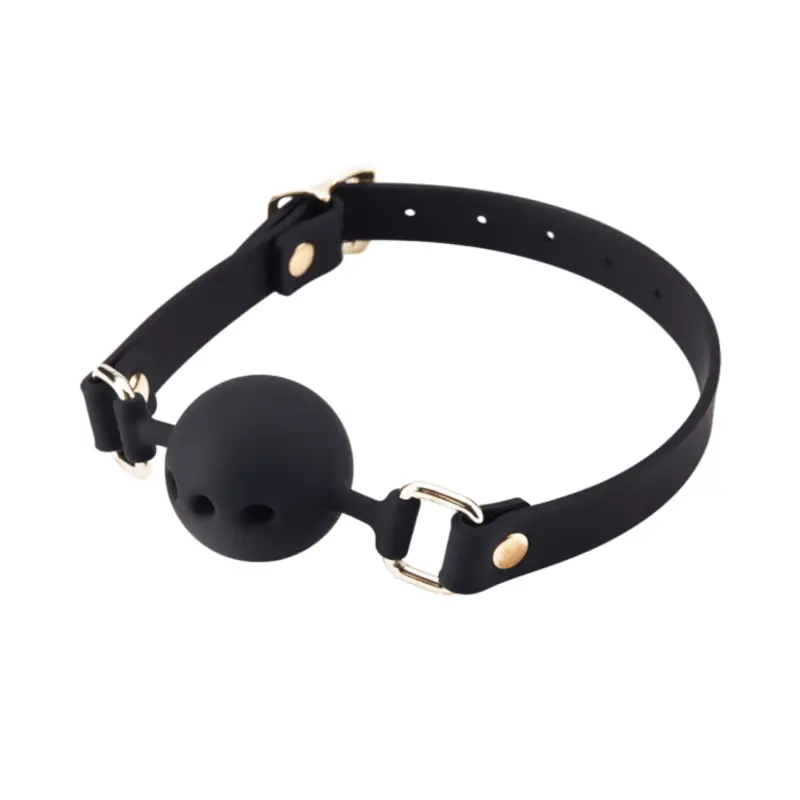
Talk about boundaries first and agree on a non-verbal stop signal that’s easy to use in your chosen position, such as repeated taps. Stay with the person wearing the gag, keep removal quick and easy, and remove it immediately at their signal or any sign of distress. A “breathable” design doesn’t guarantee an open airway.
Blocked nose? Save this experiment for another day.
What if you prefer to be quiet?
Then be quiet.
Maybe silence helps you focus. Maybe, after a day of noise, conversation and being needed by everyone, a peaceful moment with yourself or a lover sounds perfect. You don’t need to make noise to prove you’re enjoying yourself. Volume isn’t a pleasure rating.
A whisper, a moan, a scream or a quiet smile. Whatever feels good to you, let that be enough.